|
|
 |
|
Need To Plant Food Plots?
Anyone who has ever spent an afternoon overlooking a food
plot will certainly have a deep appreciation for wildlife plantings.
Even the wildlife photographer, who maneuvers silently through
a stand of pines into an opening that was planted in winter
wheat, benefits from wildlife plantings.
Food plots are very attractive to wildlife because they can
supplement their daily nutritional needs. Such plots can be
established and maintained at a relatively low cost. These plots
can be designed to serve as a source of food and sometimes cover.
Well-managed food plots have the potential to increase numbers
of wildlife, quality of health and observability.
Full Story
|
|
|
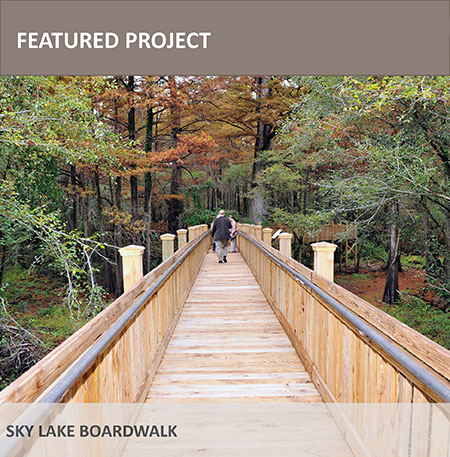
THE SKY LAKE BOARDWALK
with Clarke Reed
When
our ancestors first arrived in the Lower Mississippi River Valley
they were awestruck by the giant cypress that had thrived here
for centuries. As they cleared the fertile land, no one in the
entire Valley thought to preserve a stand, or even one, of these
spectacular trees. They are all gone…or so we thought!
Providence and a remote swamp spared the site that contains
“some of the largest and oldest baldcypress trees that
remain on earth,” according to Dr. David Stahle, Director
of the Tree Ring Laboratory at the University of Arkansas.
Sky Lake Wildlife Management Area is located approximately 8
miles north of Belzoni. With our encouragement, the Mississippi
Department of Wildlife, Fisheries and Parks acquired the 773-acre
site that will soon be enlarged to approximately 4,000 acres.
It is imperative that we protect these trees of national and
international significance, and provide access for scientists,
writers, photographers, wildlife enthusiasts and a host of the
rest of us. Consultants tell us to expect thousands of visitors
annually.
Full Story
|
|
|
Conservation Corner
(For the week of July 14, 2008)
The Water Cycle
by James L. Cummins
Water covers three-fourths of the earth’s surface. There
are many forms of water – ice, snow, rain, hail, dew,
fog and steam. The majority of this life source is sea water.
It is from our oceans that most of our precipitation comes,
although cleaned of its salt and minerals. So, how does this
happen? Water moves from land to clouds to land and back to
the ocean in an on-going cycle. This cycle is known as the water
cycle, or the hydrologic cycle. Let's take a closer look at
it.
Every year about 95,000 cubic miles of water evaporates from
the oceans and land. This water evaporates into the atmosphere,
leaving impurities behind. This evaporated moisture moves across
the earth in the form of water vapor. A small portion of this
water vapor is visible to us as fog, mist or low-lying clouds.
The water vapor then condenses, filling the clouds and then
releasing back to the earth in one of the various forms of water
depending on region, climate, season and topography.
Full
Story
|
|
|
 |
|


If
there is a parcel of land in the Mississippi worth preserving, it
is the 773 acre Sky Lake. Learn more about the Mississippi Fish and
Wildlife Foundation's efforts to preserve this stand of ancient cypress.
More...

|
|